
Understanding the Benefits of Minimally Invasive Vasectomy Procedures

For individuals and couples seeking a permanent and highly effective form of birth control, vasectomy often emerges as a leading choice. It's a decision with significant implications for family planning and personal well-being. However, many people have questions about the procedure itself, its recovery, and the overall cost.
What Is a Minimally Invasive Vasectomy?
Thankfully, advancements in medical science have transformed vasectomies into remarkably straightforward and efficient procedures. Modern techniques, such as the minimally invasive no-needle method, prioritize patient comfort and rapid recovery. This makes the process less daunting than ever before. We understand that clarity on these aspects is crucial for making an informed decision.
In this comprehensive guide, we will explore the benefits of minimally invasive vasectomy procedures. We will delve into how these advanced techniques work, their clinical advantages over traditional methods, and what to expect during recovery. Crucially, we will also examine the long-term cost efficiency of a vasectomy, helping you understand its economic value compared to other birth control options. Our aim is to provide you with all the essential information to navigate this important decision with confidence.

A minimally invasive vasectomy represents a significant evolution in male permanent contraception. At its core, the procedure involves interrupting the vas deferens, the tubes that transport sperm from the testes.
Unlike older, more invasive methods, modern techniques focus on minimizing disruption to the scrotal tissue, leading to quicker recovery and reduced discomfort.
This approach typically involves only local anesthesia, further enhancing patient safety and convenience by avoiding the risks associated with general anesthesia. The entire process is a testament to surgical refinement, designed to be as efficient and comfortable as possible.
The procedure duration for a minimally invasive vasectomy is remarkably short, often completed within 15 to 30 minutes. This brevity is a key advantage, allowing patients to return home shortly after the procedure. The focus on minimal access and precise intervention means that the body experiences less trauma, which translates directly into a more favorable recovery experience.
How Minimally Invasive Vasectomy Works
The hallmark of a minimally invasive vasectomy is its refined technique, which significantly reduces the need for extensive incisions. Instead of a scalpel, the surgeon typically uses a specialized instrument to create a tiny micro-puncture in the scrotal skin. This small opening is just large enough to access the vas deferens, which are then gently isolated.
Once exposed, the vas deferens are usually cut, and their ends are sealed. Various methods can be employed for sealing, including thermal cautery, where heat is used to seal the ends, or the application of surgical clips. Another common technique is fascial interposition, where a small layer of tissue is placed between the cut ends of the vas to create a natural barrier, further preventing reconnection. The goal of these sealing methods is to ensure permanent blockage of sperm flow.
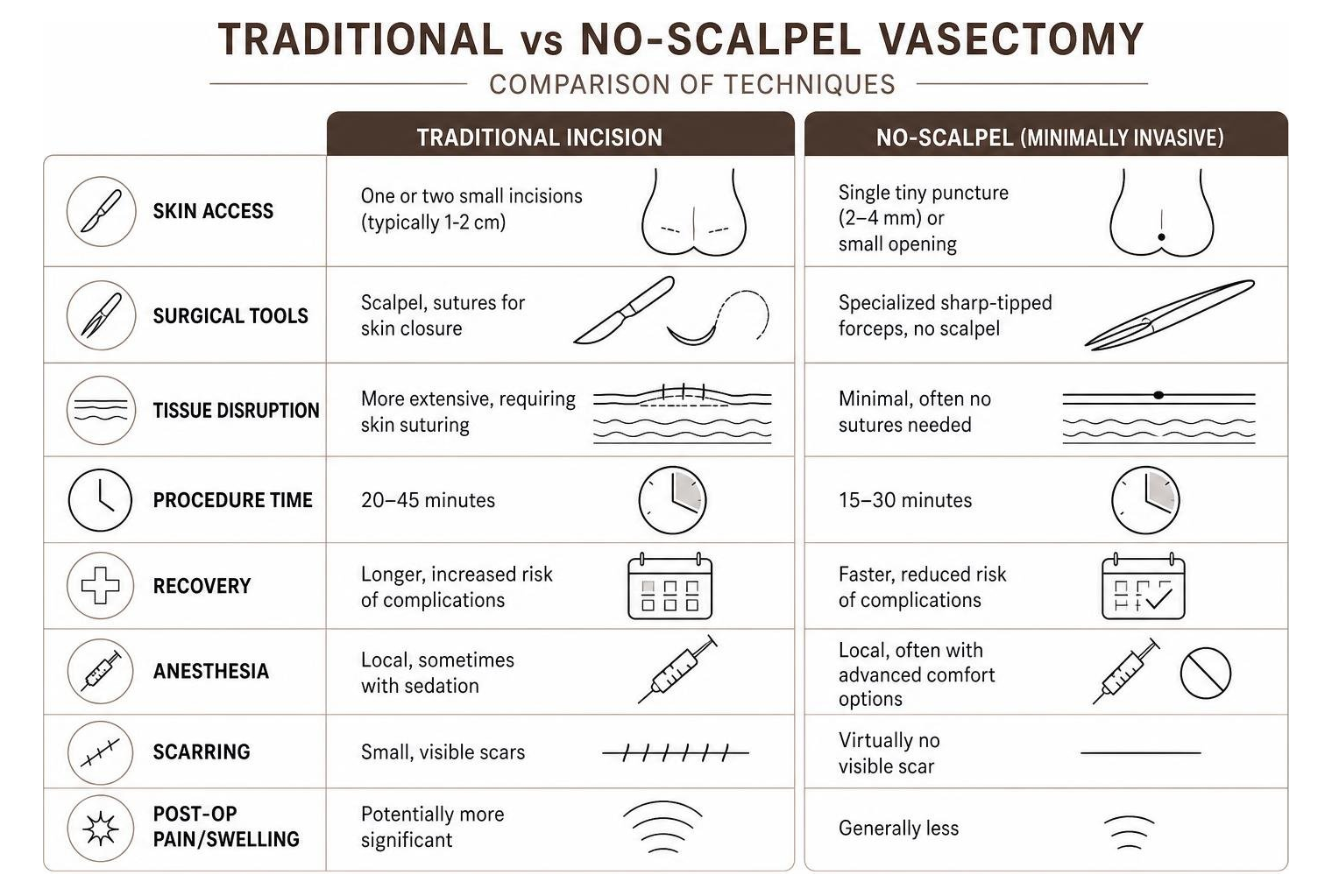
The entire process is designed for efficiency, with many procedures boasting a 15-minute runtime. This rapid completion contributes to the procedure's appeal, allowing patients to quickly resume their daily lives. The table below illustrates the key differences between traditional and modern puncture-based approaches:
Feature Traditional Incision Vasectomy Puncture-Based (No-Scalpel/Minimally Invasive) Vasectomy Skin Access One or two small incisions (typically 1-2 cm) Single tiny puncture (2-4 mm) or small opening Surgical Tools Scalpel, sutures for skin closure Specialized sharp-tipped forceps, no scalpel Tissue Disruption More extensive, requiring skin suturing Minimal, often no sutures needed for skin Procedure Time 20-45 minutes 15-30 minutes Recovery Longer, increased risk of complications Faster, reduced risk of complications Anesthesia Local, sometimes with sedation Local, often with advanced comfort options Scarring Small, visible scars Virtually no visible scar Post-Op Pain/Swelling Potentially more significant Generally less
Advanced Anesthesia and Comfort Options
Patient comfort is a paramount concern in modern vasectomy procedures, and significant advancements have been made in anesthesia and pain management. The primary method of pain control is local numbing, where an anesthetic agent is carefully administered to the scrotal area. This ensures that the patient feels little to no discomfort during the procedure itself.
For those who may experience anxiety about needles, innovative solutions like jet injection systems are available. These devices deliver the local anesthetic without a needle, using a high-pressure spray to penetrate the skin. This needle-free approach significantly enhances the patient experience, making the initial numbing process much more comfortable. For a truly comfortable experience, many clinics offer a minimally invasive no-needle option, which combines the no-scalpel technique with needle-free anesthesia.
Beyond local anesthesia, many providers offer additional comfort options. Nitrous oxide, commonly known as "laughing gas," can be administered to help patients relax and reduce anxiety during the procedure. Oral premedication, such as a mild sedative taken before arriving at the clinic, is another option for those who prefer to be more relaxed. These combined approaches ensure that patients remain comfortable and calm throughout their vasectomy, transforming what was once a source of apprehension into a manageable and often surprisingly easy experience.
Clinical Advantages Over Conventional Methods

The clinical advantages of minimally invasive vasectomy procedures over conventional methods are substantial, primarily stemming from the reduced tissue manipulation and smaller access points. One of the most notable benefits is the significantly lower risk of hematoma, which is a collection of blood outside blood vessels. With less cutting and dissection, there's less opportunity for bleeding, leading to fewer complications and a smoother recovery.
Patients also benefit from minimal scarring. The micro-puncture technique often results in a nearly invisible mark, which is a cosmetic advantage compared to the more noticeable scars associated with traditional scalpel incisions. Furthermore, the reduced tissue trauma inherently lowers the risk of postoperative infection. A smaller opening means less exposure to external contaminants and less tissue damage for the body to heal.
These factors contribute to superior postoperative comfort. Patients generally report less pain, swelling, and bruising after a minimally invasive vasectomy, allowing for a quicker return to normal activities and a more positive overall experience.
Recovery Timeline and Resuming Routine Activities
One of the most appealing aspects of a minimally invasive vasectomy is the remarkably swift recovery timeline. We typically advise patients to plan for approximately 48 hours of rest immediately following the procedure. During this period, it's crucial to minimize physical activity, apply ice packs as directed, and wear supportive underwear to reduce swelling and discomfort.
Most individuals can comfortably return to desk work or other light, non-strenuous activities within two to three days. However, more vigorous activities, such as heavy lifting, intense exercise, or athletic activity, should be avoided for about one to two weeks to allow for complete tissue healing. Sexual activity can usually be resumed within a week, provided there is no discomfort.
It's important to listen to your body and avoid pushing yourself too soon. While the recovery is generally mild, proper adherence to post-operative instructions ensures the best possible outcome and minimizes any potential complications. Your healthcare provider will provide detailed guidelines tailored to your specific situation.
Long-Term Efficacy and Semen Analysis
The long-term efficacy of a vasectomy is exceptionally high, making it one of the most reliable forms of permanent birth control. With a success rate exceeding 99.85%, it offers peace of mind for individuals and couples who have completed their families. However, it's crucial to understand that sterility is not immediate. Sperm can remain in the vas deferens beyond the point of interruption for some time.
To confirm the success of the procedure, a post-vasectomy semen analysis (PVSA) is mandatory. This follow-up test, typically performed between 8 and 16 weeks after the vasectomy, checks for the presence of sperm in the ejaculate. We adhere to American Urological Association (AUA) guidelines, which recommend a single negative PVSA to confirm azoospermia (the complete absence of sperm). Until this confirmation is received, it is essential to use alternative forms of contraception. Most men achieve post-procedure clearance within this timeframe, ensuring the procedure has been fully effective.
Long-Term Cost Efficiency and Economic Value
When considering permanent contraception, the long-term cost efficiency of a vasectomy presents a compelling economic value. While there is an initial upfront cost, comparing it to the cumulative expenses of other birth control methods over a lifetime reveals significant savings. The average cost of a vasectomy without insurance can range from approximately $300 to $3,000, with a national average often cited around $1,000 to $1,550 as of September 2026. However, this one-time investment often pales in comparison to ongoing costs.
A key factor contributing to its affordability is that most minimally invasive vasectomies are performed in an outpatient setting, such as a doctor's office or a specialized clinic, rather than a hospital. This avoids high facility fees that can significantly inflate the total bill. Many patients can also utilize Health Savings Accounts (HSAs) or Flexible Spending Accounts (FSAs) to pay for the procedure with pre-tax dollars, further enhancing the outpatient savings.
Let's look at a comparison of lifetime contraceptive costs (based on an assumed reproductive lifespan of 41 years, from age 18 to 59, where applicable):
- Vasectomy: Approximately $1,550 (one-time cost, or significantly less with insurance coverage).
- Birth Control Pills: Up to $24,600 (assuming $50 per month for 41 years).
- Intrauterine Devices (IUDs): Around $5,200 (assuming $1,300 per IUD, replaced every 12 years over 41 years).
- Condoms: Roughly $4,182 (assuming 51 uses per year at $2 per condom for 41 years).
- Tubal Ligation (Female Sterilization): Approximately $6,000 to $8,000 (a one-time surgical cost, but significantly more invasive and expensive than vasectomy).
This comparison clearly illustrates that while other methods require continuous spending, a vasectomy offers a single, relatively low payment for permanent protection, making it an economically sound choice for family planning.
Financial Factors for Minimally Invasive Vasectomy
Understanding the financial factors involved in a minimally invasive vasectomy is crucial for budgeting and planning. The in-office setting is typically the most cost-effective option, as it bypasses the higher overhead and facility fees associated with hospital outpatient departments. For insured patients, many health insurance plans cover vasectomy as a preventive service, which can significantly reduce out-of-pocket expenses. Depending on your plan and whether your deductible has been met, your out-of-pocket cost could range from $0 to a few hundred dollars. It's always advisable to verify your specific insurance coverage and deductible status before scheduling the procedure. The timing of your deductible can also play a role; scheduling towards the end of the year if your deductible is met, or early in the year if you anticipate other medical expenses, could impact your final cost.
For those without insurance, or for whom insurance coverage is minimal, cash-pay pricing is often available. Many clinics offer bundled pricing that includes the initial consultation, the procedure, and the essential follow-up semen analysis, providing transparency and predictability in costs. Additionally, low-cost or free options exist through various channels. Planned Parenthood and Federally Qualified Health Centers often provide services on a sliding-scale basis, meaning the cost is adjusted according to your income. These sliding-scale clinics can make vasectomy accessible for a wider range of individuals, ensuring that financial constraints do not entirely prevent access to this effective form of contraception.
Frequently Asked Questions About Vasectomy Procedures
We understand that making a decision about a vasectomy can bring up many questions. Our goal is to provide clarity and address common concerns, ensuring you feel fully informed and confident in your choice.
Does a vasectomy affect testosterone or sexual performance?
This is a very common and understandable concern for many men considering a vasectomy. We can confidently say that a vasectomy does not affect testosterone levels, hormone production, or sexual performance. The procedure only blocks the passage of sperm; it does not interfere with the testes' ability to produce testosterone, which is responsible for sex drive, erections, and other male characteristics.
Erectile function remains unchanged, as the nerves and blood vessels responsible for erections are not affected. Similarly, your ejaculation fluid will look and feel the same. Sperm make up only a tiny fraction (less than 5%) of the total ejaculate volume, so their absence is imperceptible. The body simply reabsorbs the sperm that are no longer able to exit, a natural process that happens with unused cells throughout the body. Therefore, you can expect your sex drive and sexual experiences to remain exactly as they were before the procedure.
How soon does sterility occur after the procedure?
While the vasectomy procedure itself is quick, sterility is not immediate. This is because there are still residual sperm present in the vas deferens beyond the point where they were interrupted. It takes time for these remaining sperm to be cleared from the reproductive system.
Typically, it takes about 8 to 16 weeks, and approximately 20 ejaculations, for the sperm count to drop to zero. During this clearance timeline, it is absolutely essential to use an alternative, reliable form of backup contraception to prevent pregnancy. Sterility is only confirmed after a post-vasectomy semen analysis (PVSA) shows no sperm present in the ejaculate (azoospermia). Your doctor will advise you on when to provide this sample and will confirm when you are cleared to stop using other birth control methods.
Can a minimally invasive procedure be reversed later if circumstances change?
While a vasectomy is intended as a permanent form of birth control, it is technically reversible through a procedure called a vasectomy reversal. This is a more complex microsurgical procedure, often performed by a specialized surgeon, to reconnect the vas deferens. The most common type of reversal is a vasovasostomy, where the two cut ends of the vas deferens are carefully reattached.
However, it's important to have realistic expectations. Vasectomy reversals are significantly more expensive than the original vasectomy, often costing between $5,000 and $15,000, and are typically not covered by insurance. More importantly, success rates for achieving pregnancy after reversal are not guaranteed and tend to decline over time. Patency rates (the return of sperm to the ejaculate) are highest when the reversal is performed within 10-15 years of the original vasectomy. The longer the interval duration since the vasectomy, the lower the chances of a successful outcome. Therefore, while reversal is an option, it should not be considered a simple undoing of the original procedure, and careful consideration should be given to the permanent nature of a vasectomy.
Conclusion
The decision to undergo a vasectomy is a significant one, marking a permanent step in family planning. However, as we've explored, modern minimally invasive vasectomy procedures have transformed this choice into a remarkably straightforward and beneficial experience. From the technical advancements that ensure minimal disruption and rapid recovery, to the comprehensive comfort options that prioritize patient well-being, the process is designed to be as easy as possible.
We've seen how these procedures offer significant clinical advantages, including reduced risks of complications and enhanced postoperative comfort. Furthermore, when considering the long-term cost efficiency, a vasectomy stands out as an economically sound choice, offering substantial savings compared to the ongoing expenses of other birth control methods.
An informed decision is the most powerful tool. By understanding the procedure, its benefits, and its economic value, you can approach this important step with confidence. A minimally invasive vasectomy offers not only effective, permanent birth control but also a procedural comfort and health value that makes it an excellent choice for many men and couples.