Calm Discipline for Dads: Respectful Ways to Set Rules (Without Yelling)

Every dad has been there. You walk into the room, toys scattered everywhere, your kid testing every boundary like it’s their full-time job. You feel the pressure rising, your voice tightening, and before you know it, you’re shouting. Practicing calm discipline can be challenging in these moments, and later, you regret it, wondering if you just made things worse.
Here’s the truth: discipline doesn’t have to mean yelling or punishment. It’s not about breaking your kid’s spirit; it’s about teaching them how to live, grow, and respect others. Our kids don’t need us to be perfect — they need us to be present, calm discipline, and consistent.
Key Takeaways - calm discipline
- Discipline should focus on teaching, not yelling; consistency and calm presence matter most.
- The article lists 10 effective strategies for Calm Discipline, such as setting clear boundaries and using natural consequences.
- Praise desired behaviors and stay connected after discipline to reinforce learning and trust.
- Provide choices instead of commands to reduce power struggles and give kids a sense of control.
- Acknowledge feelings, model emotional control, and stay consistent to foster responsibility and self-regulation.

10 Ways to Discipline Without Shouting or Hitting
Table of contents
- 10 Ways to Discipline Without Shouting or Hitting
- 1. Set Clear Boundaries in Advance
- How to discipline a 3 year old without hitting or shouting
- 2. Use Natural Consequences
- Discipline tips for 8–10 year olds who ‘won’t listen’
- 3. Give Choices, Not Commands
- Calm discipline for teens who talk back (dad guide)
- 4. Get Down to Their Eye Level
- 5. Use Time-In Instead of Time-Out
- 6. Be a Model of Emotional Control
- Single dad discipline strategies that actually work
- 7. Praise the Behavior You Want to See
- 8. Use Logical Consequences
- 9. Stay Consistent, Not Harsh
- 10. Reconnect After Discipline
- FAQs for Dads
- What Do I Need To Do - calm discipline
- You are a Great Dad, Now Show It
This guide lays out 10 proven, respectful strategies dads can use to discipline without shouting or hitting. Think of it as a practical toolbox to help you stay in control while still teaching lessons that stick.
1. Set Clear Boundaries in Advance
Kids thrive on predictability. Boundaries work best when they are simple, visible, and repeated—long before there’s a problem.
How to set them:
- Decide 3–5 “family rules.” Keep them positive and clear (e.g., “We use gentle hands,” “We speak respectfully,” “We take care of our things,” “Homework before screens.”)
- Post the rules on the fridge or a kid-eye‑level spot. Read them together each morning for a week.
- Practice the rules during calm discipline moments. Role‑play: “Show me how we ask for a turn with the tablet.”
- Pre‑brief before transitions. On the way to the store: “We’ll walk, keep hands to ourselves, and choose one snack under $3. If we forget, we leave.”
How to discipline a 3 year old without hitting or shouting
Age tweaks:
- Toddler/Pre‑K: Use pictures and hand signals. Keep to 2–3 rules.
- Grade school: Invite them to help phrase the rules; they’ll buy in more.
- Tweens/Teens: Add agreements with consequences they help choose (curfew, tech limits, chores).
Coach lines to use:
- “At home we… (state rule). Try again.”
- “What’s our homework rule?” (Have them say it back.)
Common pitfalls & fixes:
- Pitfall: Changing rules on the fly.
Fix: “I said yes yesterday; I should’ve stuck to our rule. Today we’re following it.”
Why it works: Predictable limits lower anxiety and reduce battles because kids know exactly where the rails are.
2. Use Natural Consequences
Let reality be the teacher when it’s safe and proportionate. Natural consequences stick because they aren’t “Dad’s punishment”—they’re how the world works.
When to use them:
- Forgetting a lunch → feeling hungry for a bit = remember next time.
- Leaving homework at home → a lower grade = plan a checklist.
- Refusing a jacket → feeling chilly = choosing a coat tomorrow.
Discipline tips for 8–10 year olds who ‘won’t listen’
Guardrails:
- Safety first. Don’t allow harm (traffic, severe weather, bullying).
- Stay calm and empathetic. “Ugh, that’s tough. I know you’re hungry. How can you solve it tomorrow?”
- Follow with coaching. Create a cue (door checklist, phone reminder, “backpack by the door”).
Coach lines:
- “I won’t rescue this time, but I’ll help you plan for next time.”
- “What’s one thing you’ll change so this doesn’t happen again?”
Why it works: Kids link choices to outcomes, building responsibility and problem‑solving—without power struggles.
3. Give Choices, Not Commands
Choices reduce power struggles by giving kids control within your limits.
How to frame choices:
- Offer two acceptable options you can live with: “Brush teeth before pajamas or after—your choice.”
- Use when/then: “When toys are in the bin, then we start the show.”
- For recurring issues, pre‑plan two choices and repeat them verbatim each time.
Calm discipline for teens who talk back (dad guide)
Age tweaks:
- Toddler: Two visual choices (two shirts in your hands).
- School‑age: Add a timer: “Five minutes to choose: bike or scooter to school?”
- Teens: Expand the range and include natural consequences: “You can ride with us at 7:45 or take the bus at 8:10.”
Give choices not commands/phrase list for dads
“Brush teeth before or after pajamas—your choice.”
“When toys are in the bin, then we start the show.”
“Do you want to walk or hop in the car?”
Coach lines:
- “You’re the boss of this choice inside our rule.”
- “Do you want to decide or should I choose for you this time?”
Pitfall to avoid: Offering a fake option (“Clean now or no birthday party”). Keep choices realistic and respectful.
4. Get Down to Their Eye Level
Connection calms the nervous system. Physically lowering yourself signals safety and respect.
Do this in the moment:
- Kneel or sit beside them, soften your face, and slow your breathing.
- Use a warm, low voice: “I’m listening. Tell me what happened.”
- Mirror a few of their words: “You wanted the red cup and felt mad.”
Why it works: A calmer body and face help your child’s brain shift from fight/flight to thinking/learning.
Coach lines:
- “We’re on the same team. Let’s solve it together.”
- “I’m not against you—I’m with you.”
Pro tip: Touch only if welcomed; some kids regulate faster with space.
5. Use Time-In Instead of Time-Out
A time‑in keeps the connection while you help your child regulate.
How to run a 3–5 minute time‑in:
- Move to a quiet spot (couch corner, “cozy corner”).
- Breathe together—count 4 in, 4 out, three times.
- Name the feeling: “Your body looks frustrated.”
- Problem‑solve briefly: “What’s a fix we can try?”
- Rehearse the skill (ask politely, take turns, use words).
Tools to keep nearby:
- Calm jar, stress ball, picture cue cards, noise‑reducing headphones.
Coach lines:
- “You’re safe. I’m right here.”
- “Let’s practice the skill and then you’re back to play.”
Why it works: Kids learn that emotions aren’t emergencies and that they can return to calm with support—building self‑regulation.
6. Be a Model of Emotional Control
Calm discipline is contagious. Narrate your regulation so they can copy it.
In the heat of it:
- “My voice is getting loud. I’m going to sip water and start again.”
- “I need 60 seconds. I’ll stand by the sink and breathe, then I’ll listen.”
Daily practice:
- Build a family calm plan: drink of water, three breaths, name the feeling, choose a tool (walk, squeeze ball, music). Post it.
- Share small repairs: “I snapped earlier—sorry. I should’ve paused. I’m working on it.”
Single dad discipline strategies that actually work
Coach lines:
- “Feelings are okay; hurting people isn’t. Here’s what I do when I feel mad.”
Why it works: Kids gain a step‑by‑step template for emotional literacy and impulse control.
7. Praise the Behavior You Want to See
Catch them doing right. Use specific, sincere praise to reinforce skills.
Make praise work harder:
- Name the behavior + value: “You put your shoes away without being asked—that’s responsibility.”
- Praise effort, not traits: “You kept trying that puzzle. That’s persistence.”
- Pair with a tiny privilege: choosing music, picking the family game.
Coach lines:
- “I noticed… (specific action). Thank you.”
- “That helped our family because… (impact).”
Why it works: Kids repeat what gets attention. Specific praise strengthens neural pathways for desired habits.
8. Use Logical Consequences
When a boundary is crossed, respond with a related, respectful, and reasonable consequence.
3‑R test:
- Related: Connects directly to the behavior (draw on wall → clean wall together).
- Respectful: Calm tone, no shaming.
- Reasonable: Fits the age and situation (short, teachable, not punitive).
Examples:
- Misuse of tablet → tablet rests until tomorrow + quick review of device rules.
- Rough play with sibling → pause play to practice gentle hands, then try again.
Natural consequences vs time-out—what works better?
- Natural = real-world feedback that teaches responsibility.
- Time-out = can disconnect; use sparingly and pair with repair.
Coach lines:
- “We fix what we break. Let’s clean it and talk about how to prevent it.”
- “The bike was left in the rain. Today it dries inside; tomorrow we try again.”
Why it works: Logical consequences teach cause and effect while preserving dignity.
9. Stay Consistent, Not Harsh
Consistency beats intensity. Quiet, predictable follow‑through wins over lectures.
How to stay steady:
- Set tiny, enforceable limits you can actually keep (bedtime, screens, chores).
- Use the broken‑record technique: calmly repeat the boundary + next step.
- Create if/then plans in advance: “If you’re not at the table by 6:10, dinner is over at 6:30 regardless.”
Coach lines:
- “Our rule hasn’t changed.”
- “We can try again tomorrow.”
Pro tip: If you over‑promise a consequence, repair: “That was too big. Here’s a fair one that fits our rule.”
Why it works: Predictability lowers pushback; kids stop gambling for a different answer.
10. Reconnect After Discipline
Discipline ends with repair. Kids need to feel loved, seen, and guided.
Quick repair ritual (2 minutes):
- Physical cue (fist bump, hug if welcomed).
- Words of belonging: “I love you. We’re okay.”
- One‑line lesson: “Next time, ask for the toy.”
- Tiny practice/re‑do: “Let’s try it once together.”
Coach lines:
- “Feelings come and go; our relationship stays.”
- “You’re a good kid who made a tough choice. Let’s learn from it.”
Why it works: Repair seals the learning, protects trust, and reduces repeat behavior.
FAQs for Dads
How do I discipline without yelling when I’m already triggered?
Pause for 60 seconds, breathe 4‑in/4‑out, name your feeling (“I’m frustrated”), then state the boundary and next step in one sentence. If needed, call a do‑over: “I’m starting again in a calmer voice.” What’s the difference between punishment and discipline?
Punishment aims to make a child suffer for a mistake. Discipline teaches the skill that was missing (asking, waiting, calming, repairing) and preserves the relationship. What if the other parent isn’t consistent?
Share a short list of 3 non‑negotiables you’ll both hold (safety, respect, school). For everything else, tell your child, “Different homes, different rules. In Dad’s house, we __.” Do these strategies work for neurodivergent kids (ADHD/Autism)?
Yes—with more structure and visuals. Keep rules concrete, use picture schedules, practice skills during calm times, and shorten steps. Consult your child’s therapist or school team for individualized supports. How many rules should we have?
Start with 3–5 family rules phrased positively (e.g., “Use gentle hands,” “Speak respectfully,” “Take care of our things,” “Homework before screens”). What consequence fits screen‑time battles?
Use the 3‑R test (Related, Respectful, Reasonable). Example: “Tablet rests until tomorrow; we’ll review screen rules and try again.” What do I do after a public meltdown?
Regulate first (quiet corner, car, bathroom stall). Then use a brief repair: “You’re safe. We’ll try again,” practice the skill once, and offer a snack/water. Is spanking effective?
Evidence links spanking with more aggression and anxiety over time. Teaching skills and using logical consequences lead to better long‑term behavior and trust. What if nothing seems to work?
Check basics (sleep, food, transitions), simplify rules, and be consistent for two weeks. If struggles persist, consult your pediatrician, school counselor, or a child therapist. How do I repair after I lose my cool?
Model accountability: “I yelled. That wasn’t okay. I’m sorry. Next time I’ll breathe and speak calmly. Let’s retry that moment together.”
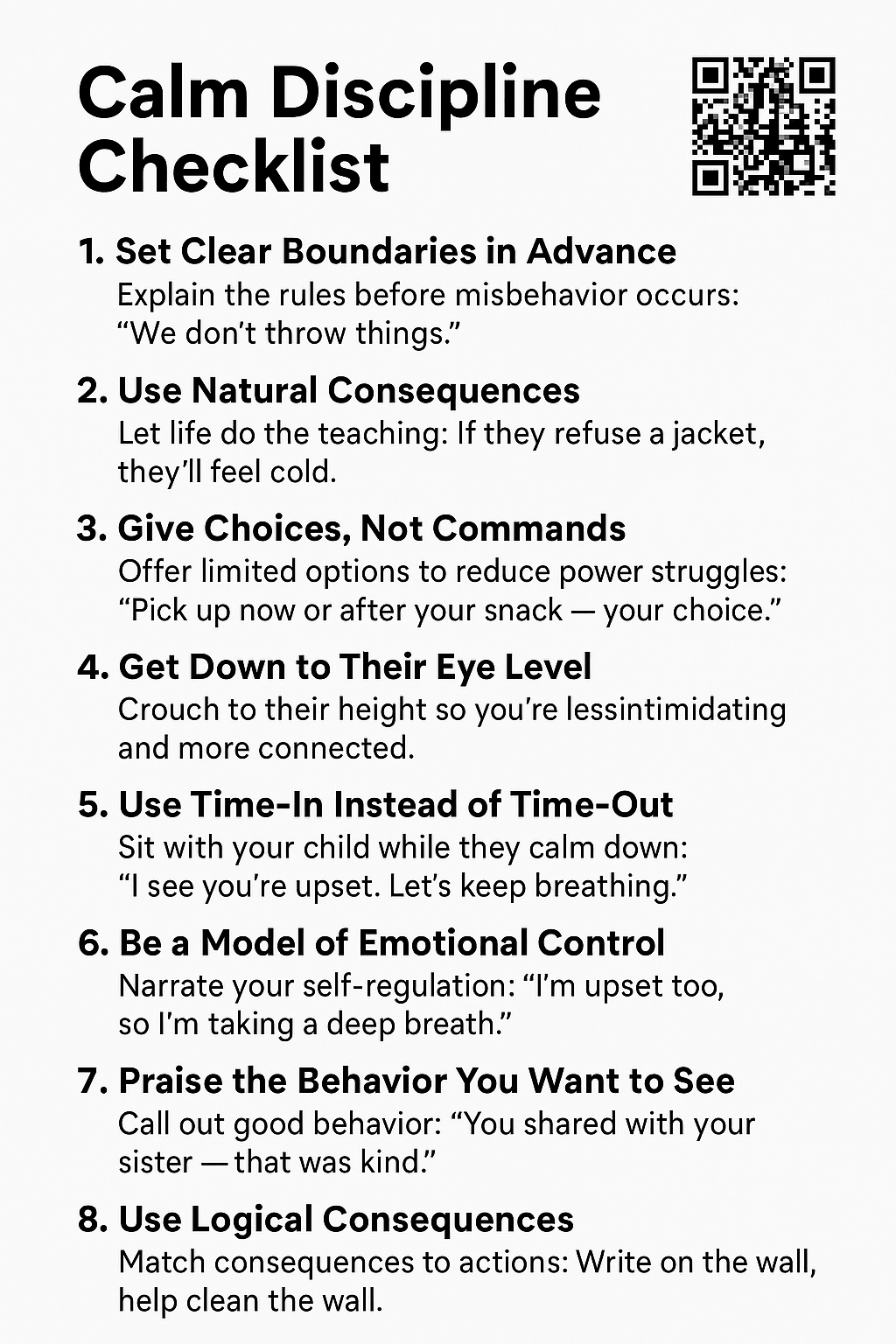
What Do I Need To Do - calm discipline
Ready to put this into practice? Grab the free 1‑page Calm Discipline Checklist (post it on the fridge), and save this post for tough moments. Want ongoing support? Join my Dad Notes newsletter for weekly scripts, quick wins, and tools that actually work.
You are a Great Dad, Now Show It
You don’t need a booming voice to be a strong dad—you need steady boundaries, connection, and follow‑through. When you set clear expectations, let natural and logical consequences teach, and circle back to repair, you raise kids who are confident, respectful, and resilient. And you show them what real strength looks like: calm, consistent love.
If this helped, share it with another dad who could use a win today.