
Travelling without a car is often seen as a limitation, but in Japan and South Korea it feels like a gift. These two countries have perfected the art of connection. Their high-speed trains, spotless metro systems, and walkable city centres mean you never have to worry about traffic jams or navigating unfamiliar roads. Instead, you’re free to sit back, watch the world fly past your window, and step off directly into the life of a city.
Car-free travel here isn’t just about getting from A to B — it’s about experiencing each journey as part of the adventure. Whether it’s gazing out at misty rice paddies on the way to Kyoto, or being swept into the buzz of a Seoul street market as you leave the subway, you realise that the transport networks are woven into the culture itself.
Japan: Where Tradition Meets Technology
Japan’s railways are as iconic as its temples and castles. Sleek, silent, and always on time, they make travel feel effortless. The train from Kyoto to Tokyo is a perfect example. In just over two hours, the shinkansen carries you from Kyoto’s serene wooden shrines and quiet tea houses to Tokyo’s skyline of glass towers and neon. One moment you’re walking under maple trees in a Zen garden, the next you’re standing in the heart of Shibuya, watching the scramble crossing light up.
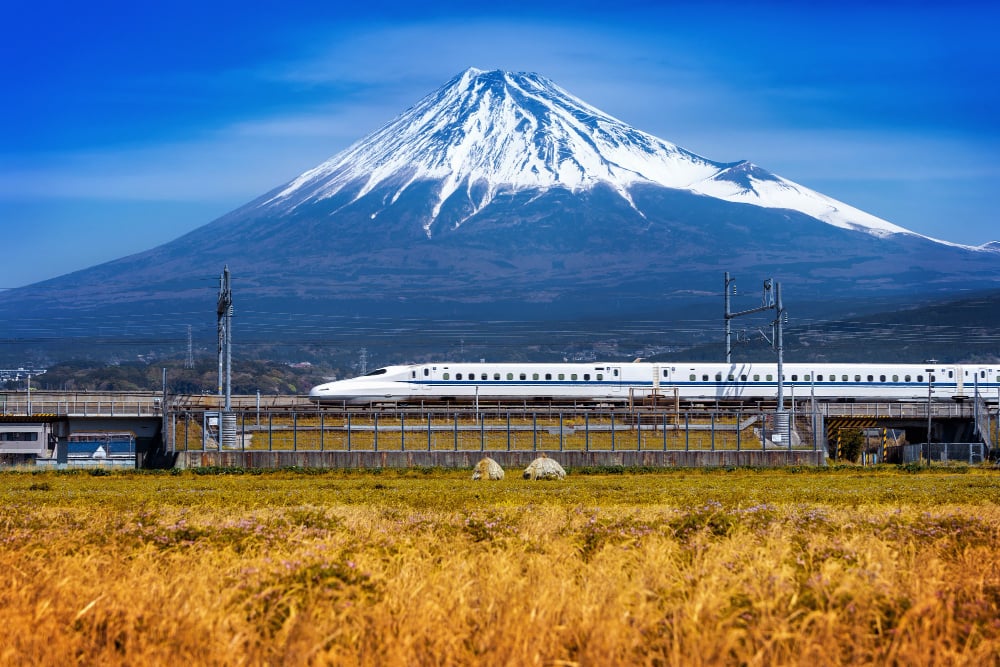
The journey is more than convenience — it’s an immersion. You settle into your seat, open a beautifully wrapped bento bought from the station, and watch Mount Fuji rise majestically in the distance. Trains here don’t just link places; they stitch together moments that become part of your memory of Japan.
Beyond the Big Cities
What makes Japan remarkable is how accessible its lesser-known corners are without a car. Local lines carry you to hot spring towns like Hakone, to Takayama’s preserved merchant houses, or to Kanazawa’s elegant samurai quarters. Each destination greets you at the station, ready to explore on foot or by a short bus ride.
Even remote treasures feel close. A train journey to Nikko brings you to mossy shrines nestled among towering cedars, while Hiroshima’s trams whisk you to the ferry for Miyajima Island and its famous floating torii gate. The smooth connections between trains, buses, and ferries create a rhythm of travel that feels natural — and leaves you free to focus on discovery rather than logistics.
South Korea: Speed and Simplicity
South Korea’s network is equally impressive. The train from Seoul to Busan has become a symbol of the country’s speed and modernity. In under three hours, it links the ancient palaces and neon streets of Seoul with Busan’s beaches, seafood markets, and laid-back coastal vibe. Sitting by the window, you watch farmland give way to mountains, then to the glittering edge of the sea — all in one seamless journey.
Korean trains are designed with comfort in mind, offering quiet carriages, roomy seats, and efficient boarding. They make long distances feel short, shrinking the country so that you can explore more in less time, without ever needing to drive.
Exploring Beyond the Capitals
Stepping away from Seoul and Busan, South Korea reveals even more. By rail, you can reach Gyeongju, the “museum without walls,” where ancient tombs and temples trace the country’s earliest history. Or you might take the train to Jeonju, where hanok houses line narrow alleys and the smell of bibimbap drifts from traditional kitchens.
Local buses and walkable neighbourhoods make these towns easy to enjoy without a car. Whether you’re tracing old stone academies, tasting regional delicacies, or hiking in a national park, the effortlessness of the journey adds to the experience. You never feel weighed down by the mechanics of travel — only lifted by the joy of it.
Why Car-Free Travel Works Here
The success of car-free travel in Japan and Korea lies in more than their efficiency. Stations aren’t just transit points; they are lively hubs filled with shops, markets, and restaurants. In Japan, it’s common to buy ekiben — station bento boxes that showcase regional dishes. In Korea, stepping out of a station might land you directly in a bustling market, where street vendors call out their specials. These places are designed around people, not cars, and that makes them welcoming for everyone.
There’s also a cultural layer. Shared travel is a way of life here. It creates connections, both practical and social, that shape how cities and towns are experienced. As a visitor, you become part of that rhythm, moving through spaces the way locals do.
The Joy of Slowing Down
Travelling without a car encourages you to slow down and notice more. On a Japanese tram, you might glimpse a grandmother tending her shop as schoolchildren chatter nearby. On a Korean metro, you’ll hear buskers filling the tunnels with music. These small details are often missed when you’re behind the wheel, but on foot or by rail they become part of the journey.
Even transfers feel like opportunities. Waiting for a ferry to Naoshima’s art islands, or catching a bus from Gyeongju station to a temple trail, you’re not stuck — you’re simply part of the flow. These pauses, like the journeys themselves, carry their own sense of discovery.
Sustainable and Stress-Free
Car-free travel is also kinder to the environment. High-speed trains replace short-haul flights, while metros and buses reduce congestion in busy cities. Both Japan and Korea are looking towards greener futures, and their transport networks are already helping to make that possible.
For travellers, there’s another gift: peace of mind. No deciphering road signs, no stressing over parking, no fatigue from long drives. Instead, you watch the countryside glide past, knowing you’ll arrive rested, right where you want to be.
Conclusion: A New Way to Travel
Car-free travel in Japan and Korea isn’t about limitation; it’s about liberation. High-speed trains link cities in hours, metros fan out into every corner of a neighbourhood, and ferries and buses complete the picture. It’s a system that gives you the freedom to move easily, but also the chance to experience travel differently — slower at times, richer always.
What you carry away are not just memories of destinations, but of journeys. The quiet thrill of watching Mount Fuji rise from a shinkansen window. The chatter of vendors as you leave a Korean station and step into a market alive with colour and sound. The feeling of being part of a flow of people who move through their countries with ease, rhythm, and purpose.
This is the beauty of going car-free in Japan and Korea: it invites you to surrender control, to let the trains, buses, and your own two feet guide the way. And in that surrender, you gain something lasting — a sense of belonging, of connection, of having touched the heartbeat of two nations that thrive on movement and community.
When you leave, it’s not just the sights you’ll remember, but the journeys themselves. The landscapes that blurred by your window, the strangers who shared your train carriage, the unexpected corners you discovered by walking just a little further. These are the stories that linger long after your trip ends — proof that sometimes, the most seamless journeys are also the most unforgettable.