


On this page
Let me be honest with you for a second.
I didn’t grow up with anything that resembled a family guide to a media plan. My parents’ strategy was pretty simple: don’t watch too much TV and go play outside.
That was it.
Fast forward to today, and things look a little different in our house. My kid has a phone, a tablet, a school Chromebook, and somehow a second tablet that appeared out of nowhere. The TV has streaming apps, gaming apps, and apparently its own app store now.
The TV has an app store.
At some point, my wife and I realized we needed something better than random rules shouted across the living room. We needed a real family media plan—something that actually helps parents guide how technology fits into daily life.
Not some laminated chart on the fridge that nobody reads.
I’m talking about a practical family guide to a media plan that keeps our home from turning into four people sitting in the same room, staring at four different screens, and calling it “family time.”
So we started building a plan that worked for us.
Here’s what we learned along the way.
 Colby
Colby
Family Guide: Get Your Kids In the Room
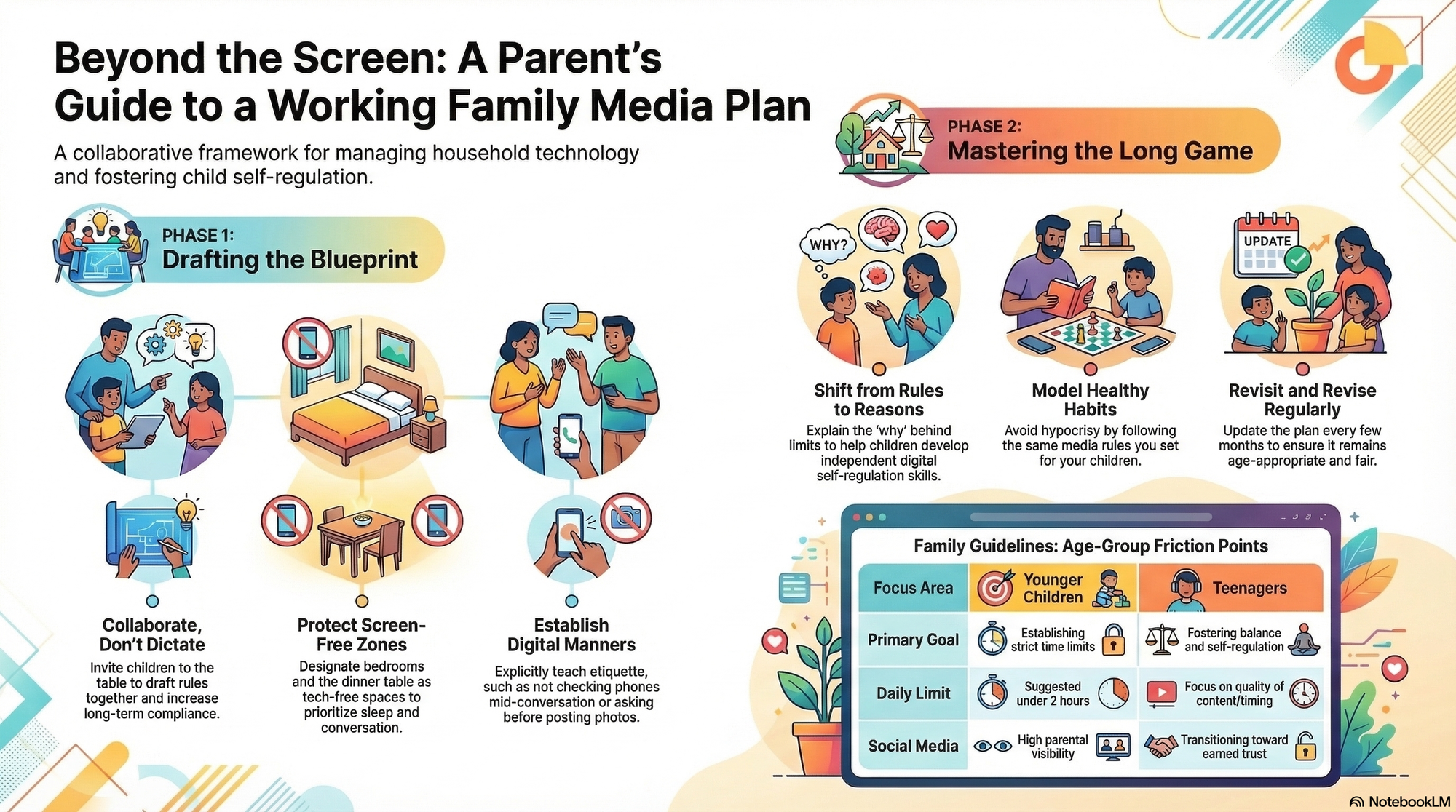
First instinct as a dad is to draft the rules solo and hand them down like a verdict. I did this. It lasted about a week before it became a daily negotiation that I was clearly losing.
Better move: sit everyone down and actually talk about it.
Ask them what apps they use most. Ask when they think screens get in the way. Ask what feels fair. You'll be surprised. Kids are more self-aware about this stuff than we give them credit for. And when they help write the rules, they're way less likely to treat them like a personal attack.
You're not letting them run the show. You're just not going in like a dictator, which, turns out, doesn't work great on kids either.
The American Academy of Pediatrics actually has a free Family Media Plan tool that lets you build a customized plan based on your kids' ages. Worth bookmarking before your first family sit-down.
"In family life, love is the oil that eases friction, the cement that binds closer together, and the music that brings harmony." — Friedrich Nietzsche
The Basics Every Plan Needs
You don't need a 12-page document. You need a few clear things that cover the real friction points.
Time limits. For younger kids, this is pretty simple. No screens before school, homework first, maybe a hard stop in the evenings. For teenagers, the conversation is less about limits and more about balance. Help them understand that screens are a part of life, not the whole thing. Common Sense Media's screen time research is a solid resource if you want data to back up the conversations you're having with your kids.
Screen-free zones. The dinner table. Bedrooms at night. Family time. These aren't punishments. They're just protected spaces where real life happens. Pulling phones out of bedrooms at night alone changed our household sleep situation dramatically. A rested kid is a completely different creature. If you want to understand exactly why, Harvard Health has a good breakdown of how screen time disrupts sleep that's worth a read.
Digital manners. This one gets overlooked. Don't check your phone mid-conversation. Ask before posting photos of other people. Don't be a jerk in online games. Understand that the internet has memory. This is basic stuff, but kids need to hear it explicitly.
Revisit It. Seriously.
A media plan isn't a decree you carve into stone.
What works for an 8-year-old is going to feel absurd to a 13-year-old, and rightly so. Every few months, do a quick check-in. Are the rules still making sense? Are there new apps in the rotation you don't know about? Does anything need to loosen up or tighten down?
This also signals to your kids that the plan is collaborative, not a life sentence. That matters.
"The most important thing in the world is family and love." — John Wooden
The Long Game: Teaching Them to Regulate Themselves
Here's the honest truth. You cannot watch your kids forever.
They'll be online at school, at friends' houses, eventually on their own. If the only reason they follow the rules is because you're watching, the rules aren't doing anything.
The real goal is raising a kid who makes decent decisions about technology when nobody's looking.
That means, as they get older, shifting from rules to reasons. Not just "phones off at 9" but why does sleep matter? What does doomscrolling actually do to your brain? What's the difference between enjoying something and needing it?
When they get the why, they make better calls on their own.
"A man's children and his garden both reflect the amount of weeding done during the growing season." — Doug Larson
 Colby
Colby
Trust Goes Both Ways
The whole thing falls apart without trust.
You trust them to make reasonable choices. They trust you to be a guide instead of a warden. That only works if the conversation stays open, not just when something goes wrong, but regularly.
And when they do well? Say so. A little extra game time on the weekend, letting them pick the movie, giving them more independence as they earn it. It all reinforces that the system is real and fair, not just a way to control them.
"It is not flesh and blood, but heart which makes us fathers and sons." — Friedrich Schiller
Technology is only going to be more present in their lives, not less. The goal was never to ban screens. It's to raise kids who know how to live with them.
Turns out that's less about enforcement and more about ongoing conversation.
And occasionally admitting that you, a grown adult, also spend too much time on your phone.
That one lands differently when you own it.
FAQ: Real Questions Dads Actually Ask
Q: What's a realistic amount of screen time for kids?
There's no magic number, and honestly the research is still catching up to how fast things are changing. A loose starting point: under 2 hours of recreational screen time per day for younger kids. For teens, focus more on what they're doing and when, rather than a strict minute count. Late-night scrolling before bed is a much bigger problem than an hour of gaming on a Saturday afternoon.
Q: My kid completely melts down when screens get taken away. Is that normal?
More common than you'd think. If shutting off a device causes a disproportionate reaction, that's worth paying attention to. Not necessarily panic-worthy, but a good signal to look at how much of their emotional regulation is tied to screens. Gradual wind-downs with five-minute warnings work better than abrupt cutoffs. And consistency over time really does help reduce the meltdowns.
Q: How do I handle it when my rules are stricter than their friends' parents?
The classic "but everyone else gets to" move. Hold your ground, but don't be dismissive. Acknowledge that different families do things differently, explain your reasoning, and make sure the rules feel fair overall. Kids are remarkably good at detecting when a rule is arbitrary versus when it actually makes sense.
Q: Should I follow my kids on social media?
Depends on the age and your relationship. For younger teens, having visibility is reasonable and most kids accept it if you're upfront about it. The key is not using it as surveillance to catch them. Use it to stay connected and know what's going on in their world. As they get older, that balance shifts toward trust. The APA has useful guidance on kids and social media if you want a deeper look at what the research actually says.
Q: What do I do if I find something concerning on their phone?
Take a breath before you react. How you respond in that first moment sets the tone for whether your kid comes to you with problems in the future. Address it calmly, ask questions before making accusations, and use it as a real conversation rather than an interrogation. The goal is for them to trust you enough to talk. That's more valuable than any single incident.
Q: My teenager says the media plan is "babyish." How do I respond?
Adjust it. If your 15-year-old thinks the rules feel like they're meant for a 9-year-old, they might be right. Revisit the plan together, give them more autonomy in areas where they've shown they can handle it, and explain clearly where the non-negotiables are and why. Treating them more like a person being consulted and less like a subject being managed goes a long way.
Q: What about my own screen habits? Do I need to model this too?
Yeah, you do. Kids notice everything. If the rule is no phones at dinner and you're sneaking a look at ESPN scores under the table, they see it. Holding yourself to the same standard isn't just fair. It actually makes the whole plan more credible. Plus, it's a good gut check on your own habits, which, if you're honest, could probably use a look too.