10 Easy Christmas Games for Families: Kids, Teens & Adults
Easy Christmas games for families include Christmas charades, name that carol, stocking guesses and a snowball toss. Start with one game everyone can play, then add a quick challenge or a quiet table game. You do not need a shopping cart full of supplies to make Christmas Eve feel like a party.
The ideas below include ready-to-use prompts, simple scoring and adjustments for different ages. Pick two or three rather than trying to squeeze all ten between dinner and presents.
Choose a Christmas game for your group
Ages and times are suggestions, not fixed requirements. Most games work seated; keep the scavenger hunt in one room when space is limited.
| Game | Suggested ages | Players | Time | Supplies |
|---|---|---|---|---|
| Christmas charades | 5+ | 4+ | 10 minutes | None |
| Name that carol | 6+ | 3+ | 10 minutes | None |
| Christmas Would You Rather | 4+ | 2+ | 5 minutes | None |
| Stocking mystery | 4+ | 2+ | 10 minutes | Stocking, household objects |
| Snowball basket toss | 4+ | 2+ | 10 minutes | Rolled socks, basket |
| Christmas drawing relay | 7+ | 4+ | 15 minutes | Paper, pencils |
| Gift-wrap partners | 7+ | 4+ | 10 minutes | Empty boxes, paper, tape |
| Christmas scavenger hunt | 4+ | 2+ | 10 minutes | Spoken or written clues |
| Holiday memory tray | 5+ | 2+ | 10 minutes | Tray, objects, towel |
| Christmas story circle | 6+ | 3+ | 10 minutes | None |
Pair younger children with older players and agree that passing is always allowed. If your family prefers a boxed game afterward, use our guide to choosing board games for family game night to match the age range and playing time.
For more ways to keep everyone involved indoors, the American Academy of Pediatrics shares simple indoor play ideas for families, including drawing and pretend play.
Christmas games with no supplies
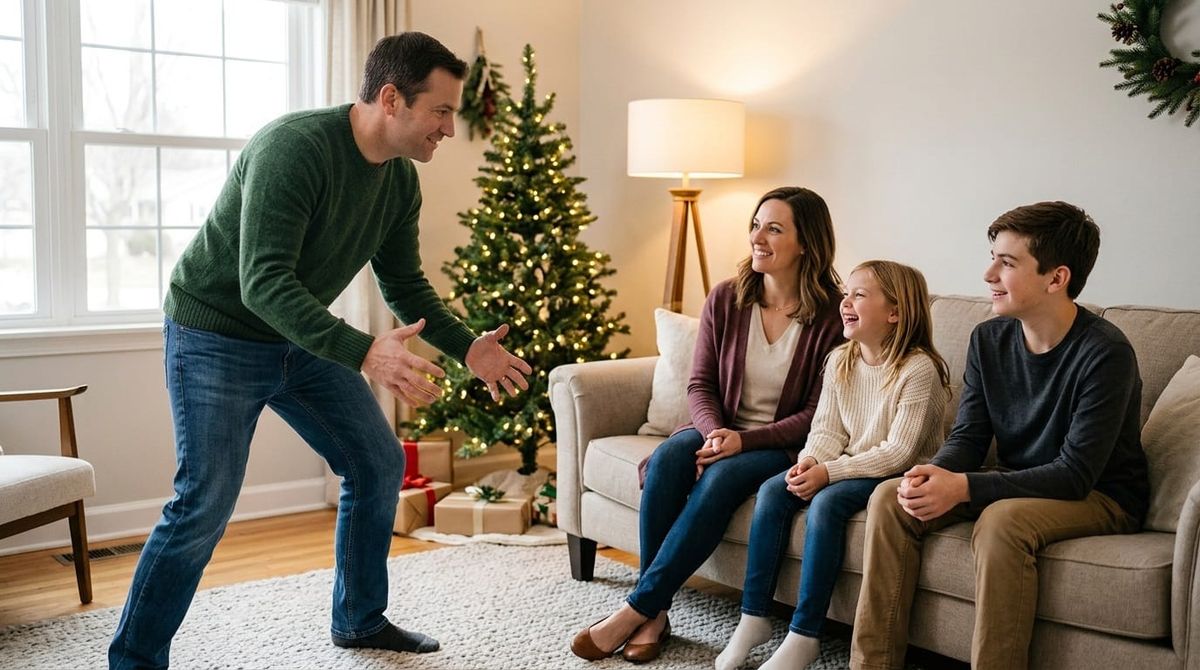
1. Christmas Charades
Split into two mixed-age teams. A player silently acts out a Christmas activity while teammates guess. Give each team about a minute per turn and one point for a correct answer; play five turns each.
Try these prompts: untangling lights, wrapping an awkward present, building a snowman, sneaking a cookie, pulling a sleigh or carrying a very large tree.
Let a younger child act with a partner. Seated players can use hand movements and facial expressions, with no requirement to stand.
2. Name that Carol
One person hums a familiar Christmas tune without singing the words. Take turns guessing rather than shouting over each other. Award one point for the title, then switch the singer.
Start with tunes your group knows, such as “Jingle Bells,” “Silent Night” or “Deck the Halls.” For teens and adults, try a shorter musical phrase. For younger children, offer two possible titles. Nobody needs to be a good singer; enthusiastic humming counts.
3. Christmas Would You Rather
Read two choices aloud. Everyone picks one and gives a short reason. There is no winner, making this a useful dinner-table warm-up.
- Would you rather wrap a hundred tiny presents or one giant present?
- Would you rather have a snowman cook dinner or a reindeer wash the dishes?
- Would you rather wear jingle-bell shoes or a light-up sweater?
- Would you rather decorate a tree with cookies or paper snowflakes?
Ask kids to invent the next question. Keep choices silly rather than personal.
Easy Christmas party games with household supplies
4. Stocking Mystery
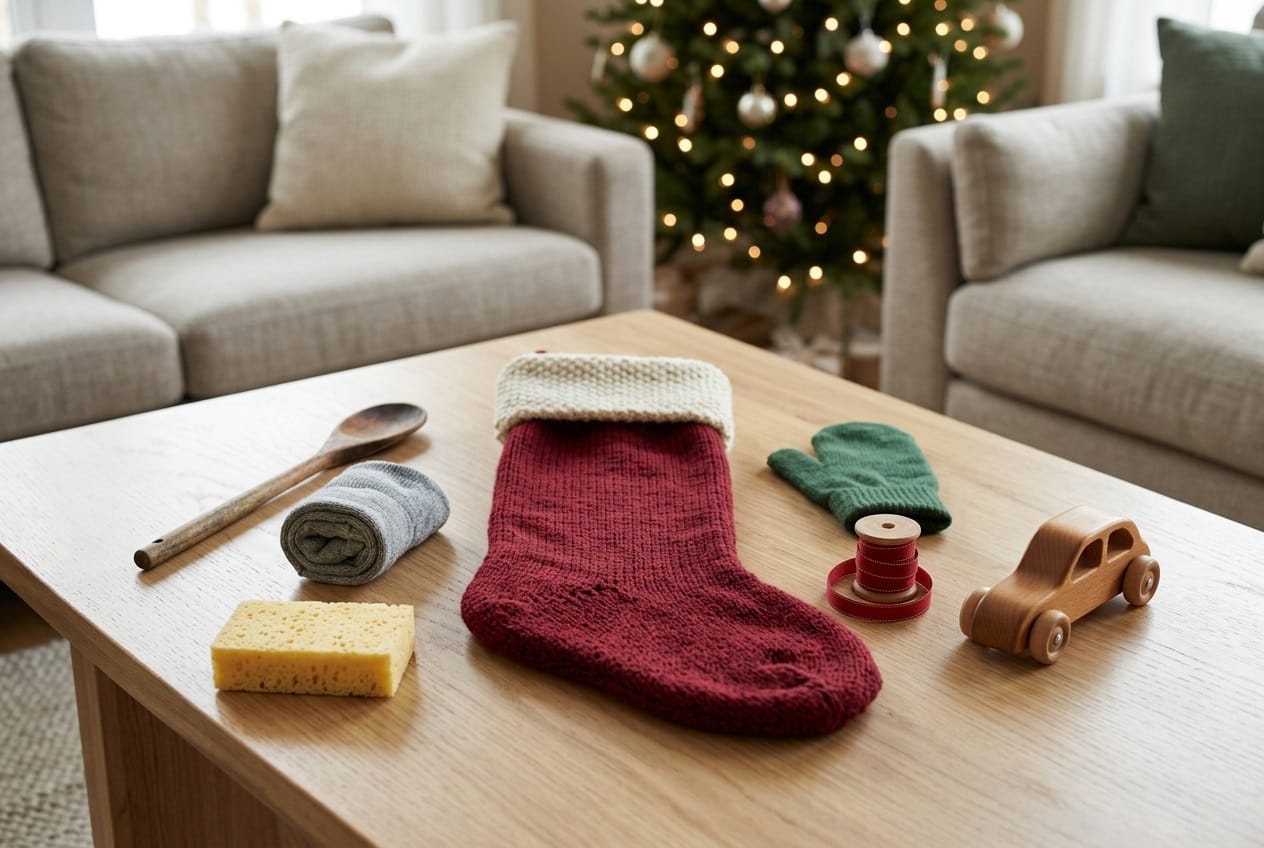
Hide one familiar object in an opaque stocking. A player feels it from the outside and makes one guess before the reveal. Rotate through six objects, scoring one point per correct answer.
A wooden spoon, rolled sock, sponge, mitten, ribbon spool and toy car make a starting set. Use large, smooth objects for younger players and avoid anything sharp or breakable. Offer a clue such as “you use this in the kitchen” when someone gets stuck.
5. Snowball Basket Toss
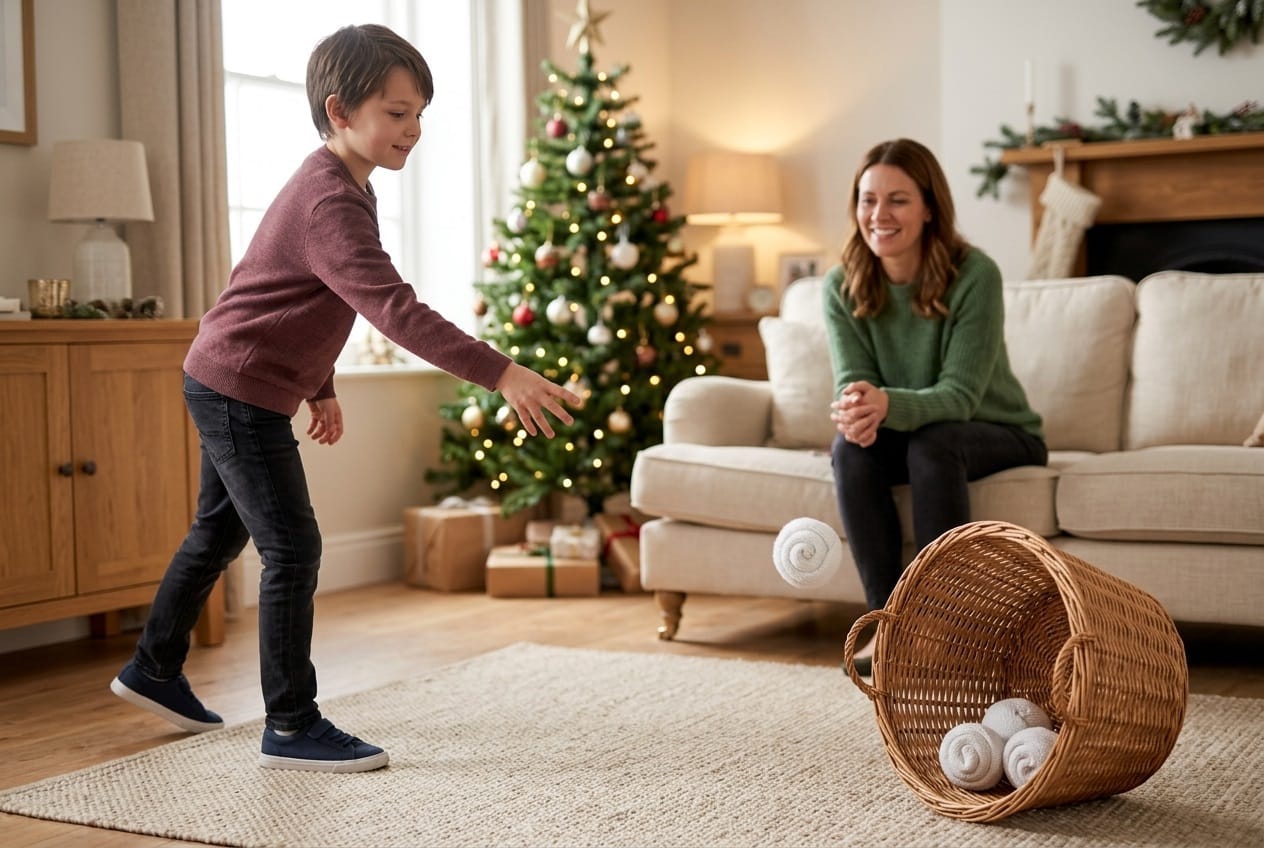
Roll three pairs of socks into soft “snowballs.” Put a laundry basket a few feet away and give each player three throws. Score one point for each sock ball that stays inside; play three rounds.
Move the basket closer for little kids or seated players, and farther away for adults. Clear fragile decorations from the playing area. For a team version, add everyone's points and try to beat the group's previous total.
6. Christmas Drawing Relay
Give each player a sheet of paper and a pencil. Everyone writes a festive scene at the top, such as “Santa walking a dog,” then passes the page left. The next person draws it, folds the original words out of sight and passes again.
The next player writes what the drawing shows, then hides the drawing before passing. Alternate pictures and descriptions until each page returns to its starter. Unfold the results together. There is no scoring; the changing story is the entertainment. Let nonreaders draw with a helper.
7. Gift-wrap Partners
Give each pair an empty box, wrapping paper and several precut strips of tape. Partners each use only one hand to wrap the box together. Allow two minutes, then let everyone show the result.
Award playful titles such as “most creative fold” rather than judging whose wrapping looks perfect. Younger kids can use both hands, and everyone can play at a table. Prepare paper beforehand so scissors are not part of the timed round.
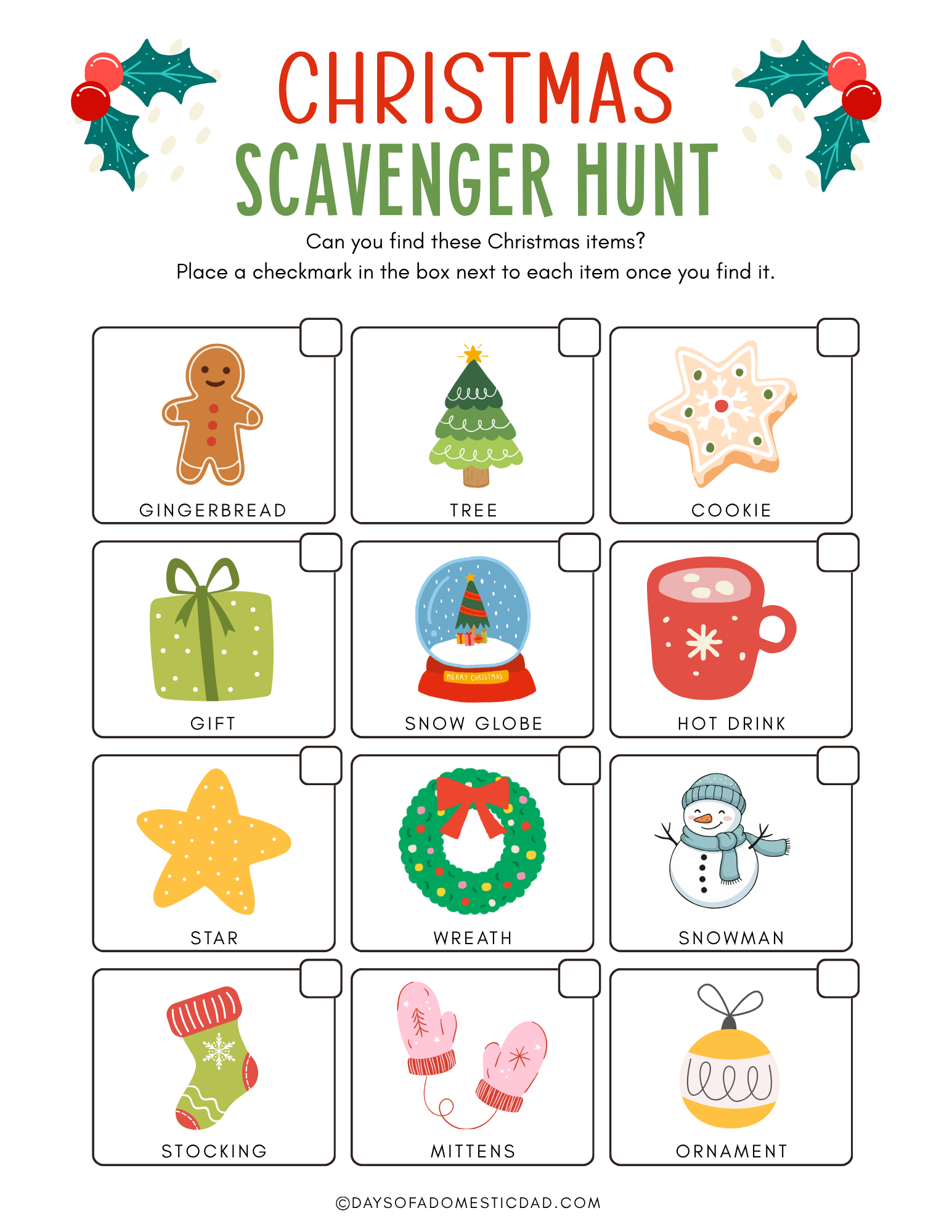
8. Christmas Scavenger Hunt
Call out one clue at a time and ask players to point to a match. Nobody needs to pull decorations off the tree or open a gift.
Look for something red, a star, a bow, something soft, a handwritten name and something that makes a sound. Use only items you have checked are present. For older players, ask them to find one object that fits two clues.
Make it cooperative: find all six together. A seated player can be the clue reader or search within a display arranged on the table.
9. Holiday Memory Tray
Place eight objects on a tray: a mitten, ribbon spool, cookie cutter, pinecone, spoon, gift tag, sock and plastic ornament. Let everyone study them for 30 seconds, then cover the tray with a towel.
Players name or write as many objects as they remember. Give one point per correct item. Start with four objects for younger kids, or remove one and ask what changed. Use sturdy objects and skip small loose decorations around toddlers.
For more games grouped by age, Harvard’s Center on the Developing Child offers an activity guide for practicing memory, attention and self-control.
10. Christmas Story Circle
Start with a sentence: “On Christmas Eve, a tiny reindeer knocked on the door.” Each person adds one sentence as the story travels around the circle. Finish after two rounds with a final sentence from the starter.
Let young children contribute a word or sound instead. For teens, agree on three things the story must include: a missing stocking, a talking cookie and a very confused snowman.
A Simple Christmas Eve Game Plan
Try five minutes of Would You Rather, ten minutes of snowball toss, then ten minutes of the memory tray. Leave time for people to chat, get a snack or opt out. For more activities between games, browse our Christmas activities, recipes and crafts.
Planning gatherings throughout the holiday season? Our Thanksgiving games for families include turkey bowling, thankful notes and a downloadable scavenger hunt.
Frequently Asked Questions
What Christmas games can a family play without supplies?
Christmas charades, name that carol, Would You Rather and a Christmas story circle need no supplies. Choose familiar prompts and let younger children play with a partner.
Which Christmas games work for kids and adults together?
Stocking mystery, snowball basket toss and holiday memory tray can work for mixed ages. Adjust the clues, throwing distance or number of objects so everyone can participate.
What Christmas games can you play sitting down?
Name that carol, Would You Rather, stocking mystery, drawing relay, memory tray and story circle can all be played seated. Place supplies within comfortable reach.
How do you play Christmas games with a large family?
Divide into mixed-age teams, keep turns short and rotate who plays or guesses. For more than about twelve people, set up two small groups and swap games after ten minutes.