
Choose the Right Winchester Repeating Arms Firearm in Canada

Key Takeaways
- Match a Winchester Repeating Arms rifle or shotgun to the activity you expect to do most often.
- Confirm the exact chambering or gauge marked on the firearm before buying ammunition.
- Review the owner's manual and current product specifications instead of relying on appearance or product names alone.
- Check current Canadian licensing, storage, transportation, and retailer requirements before placing an order.
- Consider the full setup, including eye and ear protection, a suitable case, safe storage, maintenance supplies, and optics where appropriate.
Choosing a firearm starts with its intended purpose, fit, chambering, or gauge, and the responsibilities that come with ownership. Canadian hunters and target shooters reviewing Winchester ammunition Canada options should first narrow the search to a specific rifle or shotgun category, then confirm that the model and its ammunition are suitable for lawful, safe use. Winchester Repeating Arms has a longstanding place in the history of sporting firearms, but a familiar name should not be the only reason to buy. The most suitable choice is the one that fits the shooter, matches the intended activity, accepts clearly identified ammunition, and can be stored and transported responsibly.
Why Winchester Repeating Arms Remains Relevant to Canadian Buyers
Winchester Repeating Arms is closely associated with the development of repeating rifles in North America. Historical accounts explain that Oliver Winchester reorganized the company that introduced the first Winchester rifle in 1866, and production of the Model 1866 began the following year. The company later moved to New Haven, Connecticut, in 1871. This history of the Winchester rifle provides useful context for the brand's place in firearms history.
Heritage can be meaningful to collectors and sporting shooters, but it does not replace practical comparison. Current buyers should evaluate the individual firearm's configuration, operating system, weight, stock dimensions, sighting options, maintenance needs, and available ammunition before deciding.
Match the Firearm to Its Primary Use
A clear use case makes every later choice easier. Begin by identifying where and how the firearm will be used most often.
- Big-game hunting: Consider a centerfire rifle chambered appropriately for the game, hunting distance, terrain, and applicable provincial or territorial rules.
- Small-game hunting: A rimfire rifle or suitable shotgun may be appropriate, depending on the game, location, and lawful hunting method.
- Upland hunting: Focus on shotgun gauge, barrel length, choke options, balance, and stock fit for walking field conditions.
- Waterfowl hunting: Look for a shotgun configuration that suits wet conditions and confirm the non-toxic shot requirements that apply in the hunting area.
- Target shooting: Prioritize comfortable recoil, reliable operation, practical sights or optic mounting, and ammunition availability.
- Collecting: Assess age, condition, provenance, safe mechanical condition, and whether the firearm should be fired at all before considering ammunition.
How to Compare Winchester Repeating Arms Rifles
Choose an Action That Fits the Activity
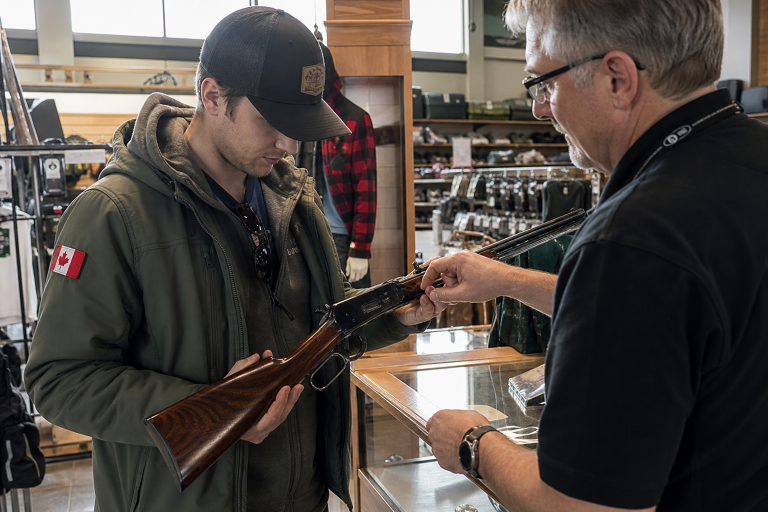
Action type affects handling, loading, maintenance, balance, and shooting rhythm. Lever-action rifles are strongly associated with Winchester's historic identity and may appeal to hunters or collectors who value compact handling and traditional design. Bolt-action rifles are commonly selected for deliberate field shooting and precision-oriented use. Other configurations should be assessed by their specific design, controls, legal classification, and intended range or hunting application. No action is automatically best for every shooter. Compare the exact model rather than making a decision based only on the category. Read the manufacturer's instructions, handle the firearm safely where possible, and confirm that the length of pull, overall weight, and controls suit the individual user.
Focus on Field-Ready Features
- Stock fit and length of pull, which influence comfort and consistent handling.
- Weight and balance, especially for long walks or extended range sessions.
- Recoil characteristics for the chosen chambering and shooter experience level.
- Iron sights, optic-ready mounting options, or the need for a compatible optic.
- Barrel length in relation to terrain, portability, and intended handling.
- Materials and finishes that suit expected weather and maintenance routines.
- Reliable access to the correct factory ammunition in Canada.
How to Compare Winchester Repeating Arms Shotguns
Shotgun selection begins with the intended use, then moves to gauge, chamber length, action type, barrel length, choke system, and stock fit. A field shotgun may be configured differently from one selected primarily for clay targets or waterfowl. Comfort matters because a shotgun that mounts naturally and balances well is easier to use safely and consistently. Shotshells must match the firearm's marked gauge and chamber specifications. Shell length, shot material, payload, and load type all matter. Do not assume that shells with similar-looking packaging, similar names, or the same gauge are interchangeable. Review the firearm manual and the ammunition packaging before loading any shotgun.
How to Avoid a Winchester Ammunition Compatibility Mistake
A search for "Winchester ammunition Canada request" often reflects a simple but important need: confirmation that a particular cartridge or shotshell is correct for a particular firearm. A Winchester ammunition Canada request is most useful when it includes the exact model, the chambering or gauge stamped on the firearm, the intended activity, and the buyer's province or territory.
- Read the chambering or gauge marking on the barrel, receiver, or other manufacturer-marked location.
- Match that marking exactly to the ammunition label.
- For rifles, confirm cartridge designation and select a bullet type suitable for the lawful intended purpose.
- For shotguns, confirm gauge, chamber length, shot type, and load information.
- Consult the firearm's owner's manual or official specifications if anything is unclear.
- Ask a qualified retailer for clarification before purchase or use when markings are worn, unfamiliar, or uncertain.
Canadian Ownership, Storage, and Transport Considerations
Firearms and ammunition purchases in Canada may require documentation and procedures that depend on the firearm and the buyer's circumstances. Requirements, classification rules, retailer practices, and shipping conditions can change, so confirm the current details before ordering. This article is general information, not legal advice. Safe handling begins before a firearm leaves the store. The RCMP states that non-restricted firearms must be unloaded during transportation, and its guidance explains expectations for secure storage, including locking measures and the use of secure cabinets, containers, or rooms. Review the current rules for storing and transporting firearms before making travel or storage plans.
How Al Flahertys Can Help With the Buying Process
Al Flahertys is a Canadian outdoor retailer located at 2066 Dufferin Street in Toronto, Ontario. Buyers can use a retailer's product listings and staff support to compare available Winchester Repeating Arms options with related ammunition, optics, cleaning equipment, cases, storage products, and hearing and eye protection. Before completing a purchase, confirm stock status, the exact product configuration, ammunition availability, shipping conditions, and any required order documentation. Bringing the exact model name and chambering or gauge to the conversation helps prevent avoidable compatibility errors.
Questions to Ask Before You Buy
- What will this firearm be used for most often?
- Does the selected model fit comfortably and allow safe, controlled operation? license
- What exact chambering or gauge is marked on the firearm?
- Is suitable ammunition available for the planned activity?
- What current licence, documentation, and transport requirements apply?
- Where will the firearm and ammunition be stored securely?
- Which accessories are essential for safe use and maintenance?
Conclusion
A well-chosen Winchester Repeating Arms firearm is the result of careful matching, not impulse. Start by identifying the intended use, whether for hunting, target shooting, collecting, or another lawful purpose, and then compare the specific model’s fit, configuration, handling characteristics, and features. Consider how the firearm aligns with the user’s experience, intended environment, and practical requirements, rather than choosing solely based on appearance or brand reputation. Ammunition compatibility should always be confirmed using the firearm’s markings and the manufacturer’s current manual, with no assumptions based on similar-looking cartridges. It is also important to verify current Canadian licensing, storage, transportation, and other applicable requirements before making a purchase or using the firearm. Taking time to review these factors supports a more informed, responsible, and confident ownership decision.
Canadian safety and legal information
This article is general educational information, not legal advice. Firearm classifications, licensing, transfer, storage and transportation rules can change and may differ by situation. Before a purchase or transfer, confirm the current requirements with the RCMP’s guidance on buying and selling firearms and follow the manufacturer’s instructions for the exact model.